
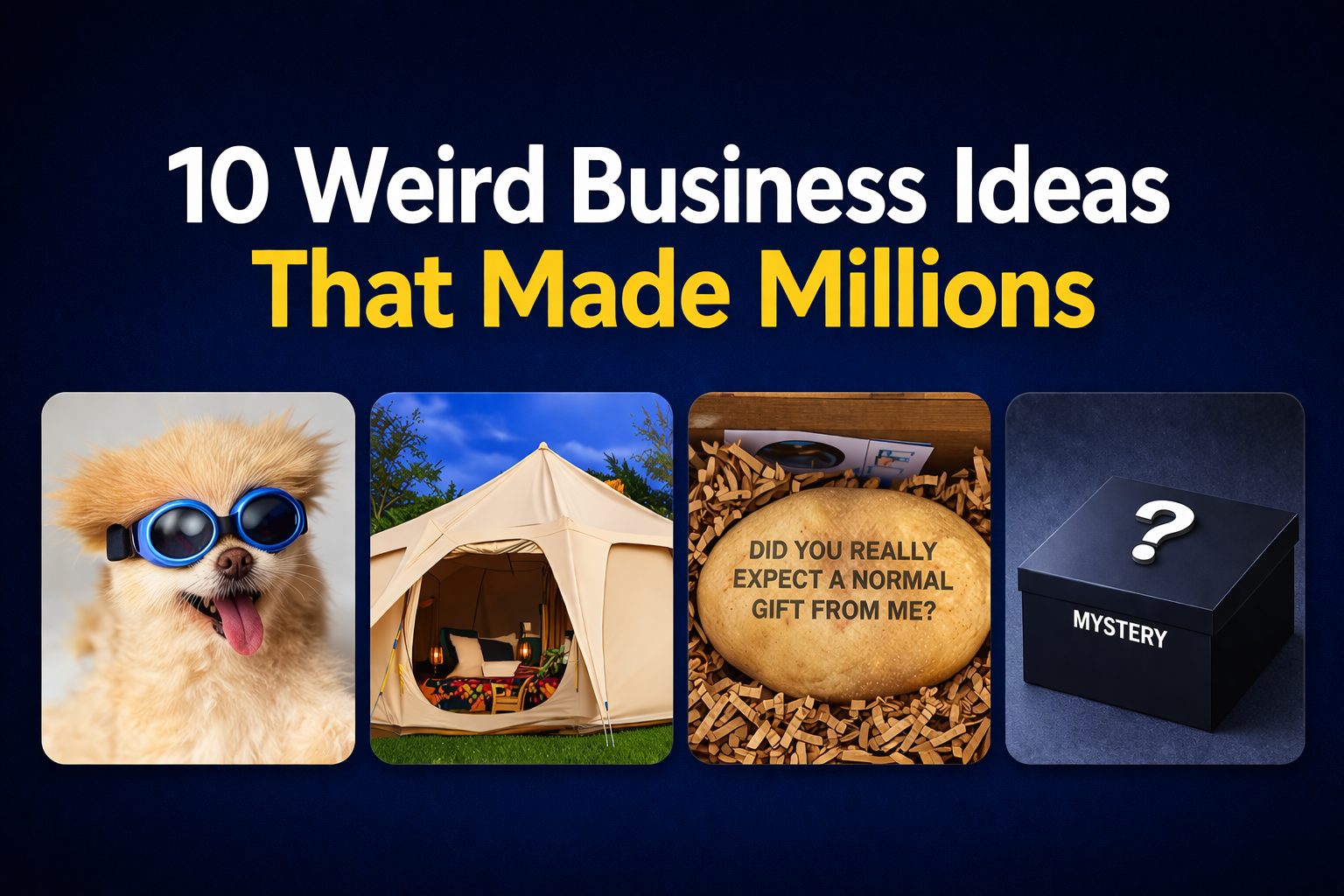
Some of the most profitable businesses in the world didn’t start with brilliant ideas—they started with ideas that sounded ridiculous.
People have made millions selling rocks as pets, sending messages on potatoes, renting chickens, and even offering professional cuddling services. On the surface, these ideas seem random, unnecessary, or even laughable. Yet somehow, they worked—and not just for a short moment, but often long enough to generate serious revenue.
So what’s really going on here?
This isn’t about luck or randomness. These businesses succeed because they tap into something most “normal” ideas ignore: attention, curiosity, and simplicity. In many cases, the product itself isn’t the main value—the way it’s presented, shared, and experienced is what drives growth.
In this article, you won’t just see a list of weird business ideas that made millions. You’ll also understand why they worked, what patterns they follow, and how you can apply the same thinking to build something of your own—even if your idea feels a little unconventional.
Table of Contents
15 Weird Business Ideas That Made Millions
Renting Out Chickens to Suburban Families
The idea of renting chickens didn’t come from a viral trend—it came from real, everyday questions. In 2013, Jenn and Phil Tompkins, a couple based in Pennsylvania, noticed that many suburban families were curious about raising chickens but hesitant to commit long-term. People wanted fresh eggs and a taste of backyard farming, but they weren’t ready to deal with years of care, maintenance, and uncertainty.
Instead of selling chickens, they created Rent The Chicken, a service that delivers hens, a coop, and basic supplies for a limited period—usually a few months. Families could experience raising chickens without the long-term responsibility. The idea spread organically, and over time, the business expanded across multiple states and into Canada through a partner-based model.

Why this works
- Removes long-term commitment: Customers can try the experience without the risk of ownership
- Taps into lifestyle trends: Homesteading and sustainable living are growing in popularity
- Simple, clear value proposition: “Try raising chickens” is easy to understand and appealing
What you should take from this
- Turn ownership into a trial: Let people experience something before committing
- Repackage existing products: You don’t need a new invention—just a new way to offer it
- Start local, then expand: Validate demand in one area before scaling
Potato Message Delivery Service
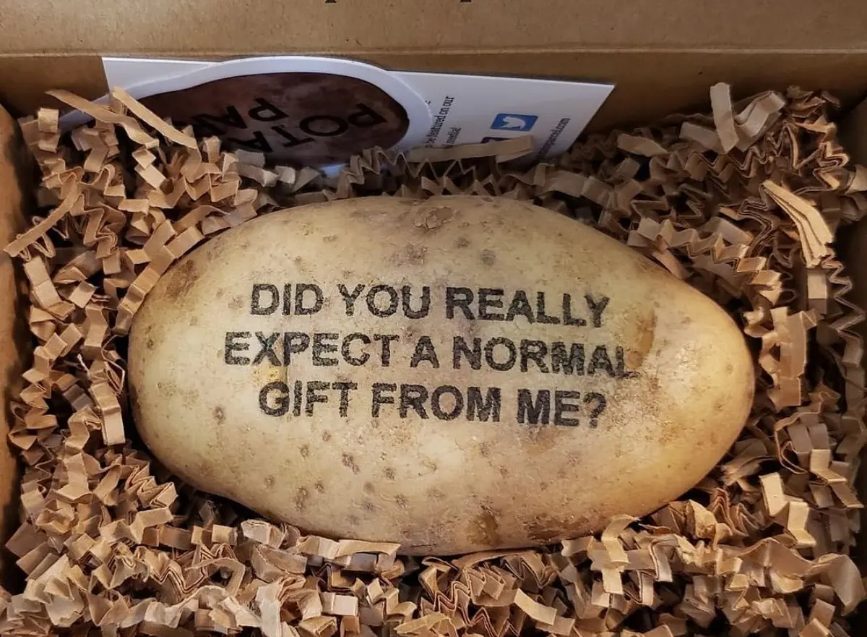
The idea of sending messages on potatoes started as a joke—but quickly turned into a real business. In 2015, Alex Craig launched Potato Parcel, a simple service that lets customers send personalized messages printed on a potato.
What began as a small experiment gained unexpected traction. People weren’t buying potatoes—they were buying a funny, unusual way to communicate. The concept became widely known after appearing on Shark Tank, helping the business reach a much larger audience.
At its core, the idea is extremely simple: take an ordinary object and turn it into a shareable experience. That simplicity is exactly what made it spread.
Why this works
- Built for sharing: The idea is unusual enough that people want to show it to others
- Clear and instant understanding: No explanation needed—“a message on a potato” says it all
- Emotion-driven purchase: Customers buy it for humor, surprise, or novelty
What you should take from this
- Novelty can be the product: You don’t always need utility—sometimes uniqueness is enough
- Simple ideas spread faster: If people understand it instantly, they’re more likely to share
- Make it easy to gift or share: Shareability can drive demand more than function
Fake Luxury Lifestyle Rentals
The idea of renting a “luxury lifestyle” didn’t start as a traditional business—it emerged from social media behavior. As platforms like Instagram grew, more people wanted to present a high-end lifestyle online, even if they didn’t actually own luxury assets.
In cities like Los Angeles and Dubai, studios began offering staged environments that look like private jets or luxury interiors. Customers can rent these spaces for short sessions, take photos, and create the illusion of wealth on social media. Similar services also include renting high-end cars purely for photoshoots.
There isn’t a single dominant company in this space. Instead, it’s a fragmented market driven by local studios and rental providers responding to demand.

Why this works
- Sells perception, not ownership: Customers pay for how things look, not what they actually are
- Driven by social media culture: Image and status are valuable in online environments
- High perceived value, short usage: A few minutes of content can justify the cost
What you should take from this
- You can monetize appearance: Value doesn’t always come from functionality
- Understand how people present themselves online: Behavior on social media can create new markets
- Short-term access can replace ownership: People often prefer temporary experiences over long-term costs
Professional Cuddling Services
The idea of professional cuddling emerged in the early 2010s, as conversations around loneliness, stress, and human connection became more visible. Some entrepreneurs realized that many people weren’t looking for romantic or sexual experiences—they were simply seeking safe, platonic physical comfort.
Platforms like Cuddle Comfort and services such as Snuggle Buddies were created to meet this need. They connect clients with trained cuddlers who offer sessions focused on non-sexual touch, such as hugging or lying side by side. These sessions follow strict guidelines to ensure boundaries and safety, and clients typically pay by the hour.
What makes this business unusual is that it monetizes something deeply human but rarely formalized: physical closeness without emotional or romantic commitment.

Why this works
- Addresses real emotional needs: Loneliness and lack of physical connection are increasingly common
- Clear boundaries build trust: Non-sexual positioning makes the service more accessible
- Simple service model: Time-based pricing makes it easy to understand and scale
What you should take from this
- Unspoken needs can be valuable: Not all demand is obvious or openly discussed
- Clarity reduces discomfort: Clear rules can make unusual services acceptable
- You can productize human experiences: Even intangible needs can become structured services
Renting Out Backyard Space for Camping
The idea of renting out backyard space for camping grew out of the broader sharing economy, where people began monetizing underused assets. Instead of hotels or traditional campsites, travelers started looking for more affordable, private, and unique outdoor experiences.
A key example is Hipcamp, founded in 2013 by Alyssa Ravasio. The platform allows landowners to list private spaces—including backyards, farms, and open land—for camping. What started as a way to discover campsites on public land evolved into a marketplace for private hosting.
This model opened the door for everyday homeowners to earn income from spaces that would otherwise go unused, while offering travelers a different kind of stay.

Why this works
- Turns idle space into income: Homeowners monetize land without major investment
- Matches changing travel preferences: People want more private, local, and unique experiences
- Platform-driven trust and demand: Marketplaces reduce friction for both hosts and guests
What you should take from this
- Look for underused assets: Value often exists in what people already own
- Access can be more valuable than ownership: Customers don’t need to own land—they just need temporary use
- Platforms can unlock new markets: Technology can connect supply and demand that didn’t exist before
Mystery Box Subscription (Hyper-Niche)
Subscription boxes have existed for years, but their real success comes from going deep into specific niches rather than targeting a broad audience.
A strong example is Hunt A Killer, launched in the U.S. around 2016. Instead of sending random products, the company delivers a monthly mystery experience where customers solve a fictional crime case over time. Each box contains clues, documents, and puzzles that build an ongoing narrative.
What makes this different is that the product isn’t just physical items—it’s the experience of solving something. The company focuses heavily on a specific audience: fans of true crime and immersive storytelling.

Why this works
- Targets a clearly defined niche: True crime fans are highly engaged and willing to spend
- Recurring revenue model: Monthly subscriptions create predictable income
- Experience over product: The value comes from engagement, not just physical items
What you should take from this
- Go narrower, not broader: A specific audience can be more valuable than a large one
- Build around experience, not just products: Engagement increases retention
- Use subscription to stabilize revenue: Repeat customers matter more than one-time sales
Breakup Service
The idea of a breakup service sounds unusual, but it came from a very real problem. In 2015, Canadian entrepreneurs Mackenzie Rapp and her partner Evan launched The Breakup Shop after noticing how many people struggled to end relationships. Instead of dealing with awkward conversations, customers could pay to have someone else deliver the breakup message on their behalf.
The service offered different options, including text messages, phone calls, and even mailed letters. At one point, they also created “breakup gift boxes” as a humorous way to soften the situation. The concept quickly gained media attention and went viral, attracting customers curious about outsourcing such an uncomfortable task. However, the business eventually shut down, showing that not all viral ideas turn into long-term companies.
Why this works
- Solves an uncomfortable problem: Many people avoid difficult conversations like breakups
- Highly shareable concept: The idea itself attracts media and social attention
- Clear and simple offer: Customers instantly understand the service
What you should take from this
- You can monetize awkward situations: Difficult or emotional tasks can become services
- Viral ideas aren’t always sustainable: Attention doesn’t guarantee long-term success
- Clarity drives interest: The simpler the idea, the easier it spreads
Air-in-a-Can (Vitality Air)
The idea of selling bottled air may sound absurd, but it became a real business with Vitality Air. Founded in 2014 by Moses Lam and Troy Paquette, the company started as an experiment when they listed bags of fresh air on eBay—and people actually bought them.
Seeing the unexpected demand, they developed a product that captures air from the Rocky Mountains and packages it in portable canisters. The company later focused on markets with higher pollution levels, particularly in parts of Asia, where clean air is perceived as more valuable.
While bottled air is often viewed as a novelty, it also connects to real concerns about air quality, which helped the business gain media attention and international customers.

Why this works
- Combines novelty with a real concern: Air pollution makes the concept more relatable
- Strong media appeal: The idea is unusual enough to attract coverage
- Simple, portable product: Easy to understand and use
What you should take from this
- Unusual ideas can gain attention faster: Being different helps you stand out
- Pair novelty with real-world issues: This increases perceived value
- Test small before scaling: Even a simple experiment can validate demand
Do Nothing” Experience Packages
The idea of “doing nothing” as a paid experience comes from a broader cultural shift rather than a single company. Inspired by concepts like Niksen—a Dutch practice that encourages intentional idleness—some wellness retreats have started offering experiences centered around rest, stillness, and minimal activity.
As burnout and constant productivity pressures increased, certain retreats in Europe and Asia began designing programs with no fixed schedules, no structured activities, and no expectations to “achieve” anything. Guests are encouraged to simply rest, disconnect, and slow down.
There isn’t a single dominant brand leading this space. Instead, it exists as a growing trend within the wellness and retreat industry.
Why this works
- Responds to burnout and overload: Many people are actively seeking ways to disconnect
- Simplicity becomes a premium: Doing less is positioned as valuable
- Clear emotional appeal: Rest and relief are strong motivators
What you should take from this
- Trends can create new markets: Cultural shifts often lead to business opportunities
- Less can be more: Value doesn’t always come from adding features
- Positioning matters: Framing “nothing” as intentional makes it meaningful
Doggles – Sunglasses for Dogs
The idea of sunglasses for dogs may sound unusual, but it came from a simple observation. In the late 1990s, Roni Di Lullo noticed that her dog was squinting in bright sunlight. Instead of ignoring it, she began experimenting with ways to protect her pet’s eyes.
This led to the creation of Doggles Inc., a company focused on protective eyewear designed specifically for dogs. The product wasn’t just a novelty—it used UV-protective lenses and adjustable straps to fit a dog’s head comfortably.
At first, the idea seemed strange to many people. But over time, Doggles gained traction, especially among pet owners who traveled with their dogs or had working animals exposed to harsh conditions. The product has been sold internationally and remains one of the most recognizable examples of a “weird” idea turning into a real business.

Why this works
- Solves a real but overlooked problem: Dogs can experience eye irritation just like humans
- Combines function with novelty: It’s both useful and visually interesting
- Strong niche audience: Pet owners are willing to spend on their animals
What you should take from this
- Pay attention to small observations: Many ideas come from everyday moments
- Unusual doesn’t mean unnecessary: Some needs are simply ignored, not nonexistent
- Test and refine before scaling: Product fit mattered more than the initial idea
Doggles is a great reminder that a unique pet business can start with a simple observation and grow into a memorable brand. If this story has inspired you to explore your own opportunity, check out these pet business ideas to find a concept that fits you. Once you have an idea in mind, you can start thinking about the right pet store names to give your new business a distinctive identity.
Pet Rock — Selling Rocks as Pets
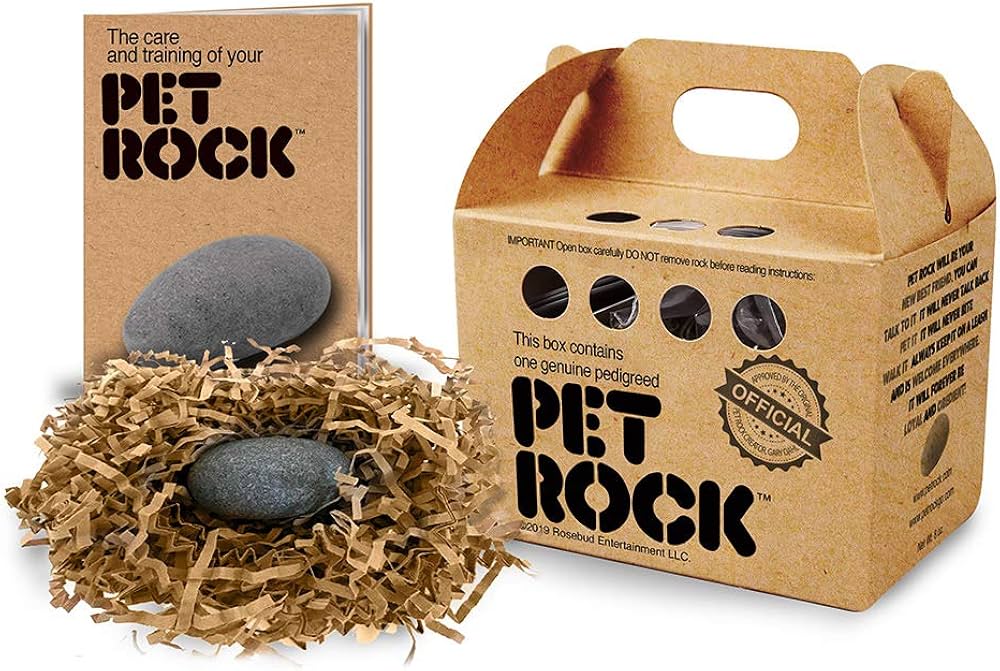
The idea of selling rocks as pets began as a joke—but quickly turned into one of the most famous novelty businesses ever created. In 1975, Gary Dahl came up with the concept after hearing friends complain about how difficult it was to care for real pets.
Instead of dismissing the idea, he turned it into a product. The Pet Rock was simply an ordinary stone packaged in a small cardboard box, designed to resemble a pet carrier. It also came with a humorous instruction manual that explained how to “care” for the rock.
What made it successful wasn’t the product itself, but how it was presented. The packaging, storytelling, and humor turned something completely ordinary into a highly shareable gift. Within a few months, millions of units were sold.
Why this works
- Pure novelty and humor: People bought it as a joke or gift, not for utility
- Strong packaging and presentation: The story made the product feel intentional
- Easy to understand and share: The idea spreads instantly
What you should take from this
- Presentation can create value: Even the simplest product can become interesting
- Ideas don’t have to be serious to sell: Entertainment itself can drive demand
- Timing and context matter: The concept worked because it matched the moment
You may also be interested in exploring:
- 18+ Unique Food Business Ideas to Launch and Succeed
- 10 Mobile Business Ideas You Can Start With Under $500 (2026 Guide)
- 20 Family Business Ideas to Build Wealth Together
- 25 Profitable Fitness Business Ideas to Start in 2026
The Real Patterns Behind Million-Dollar Weird Ideas
At first glance, these businesses feel completely random. Renting chickens, selling air, or offering cuddling services don’t follow the usual logic of “solve a big problem, build a scalable product.”
But when you look closer, they’re not random at all.
They follow a set of patterns that make them easier to understand, easier to share, and easier to sell—especially in a crowded market where most ideas look the same.
Simple enough to explain instantly
One thing these ideas have in common is clarity. You don’t need a long explanation to understand them.
- “Send a message on a potato”
- “Rent chickens for a few months”
- “Sunglasses for dogs”
Each idea can be understood in seconds. That matters more than people think. When something is easy to understand, it becomes easier to remember, easier to share, and easier to act on.
Use attention as a built-in advantage
Most traditional businesses have to fight for attention. These ideas start with it.
Because they are unusual, people naturally react to them—whether with curiosity, humor, or even disbelief. That reaction becomes free distribution.
- People talk about it
- Share it
- Send it to friends
In many cases, the product itself isn’t what spreads—the idea does.
Don’t invent something new, just reframe something familiar
Very few of these businesses are truly “new.”
Instead, they take something that already exists and present it differently:
- Chickens → turned into a rental experience
- Air → packaged and sold as a product
- Physical comfort → structured as a service
This makes the idea feel fresh without requiring complex innovation. It’s not about creating something from scratch—it’s about changing how people see it.
Tap into emotion, not just utility
A lot of “normal” business ideas focus on solving practical problems. These ideas often succeed because they do something else—they make people feel something.
- Humor → potato messages
- Comfort → cuddling services
- Status → luxury lifestyle rentals
People don’t always buy because they need something. They buy because it’s interesting, funny, comforting, or worth sharing.
Make it easy to say yes
Weird ideas can feel risky to customers. The businesses that succeed reduce that risk.
- Renting instead of buying
- Trying instead of committing
- Paying for experience instead of ownership
Lower commitment makes unusual ideas more accessible. It turns hesitation into curiosity—and curiosity into action.
Focus on a specific group, not everyone
None of these ideas tries to appeal to the mass market from the beginning.
Instead, they target people who are already interested:
- Pet owners
- True crime fans
- Social media creators
That focus makes marketing easier and increases the chances of early traction.
How to Turn a Weird Idea Into a Real Business
Coming up with a weird idea is easy. Turning it into something people actually pay for is the hard part.
Most ideas in this space don’t fail because they’re strange—they fail because they’re not executed properly. The difference between a joke and a business often comes down to how quickly and clearly you test it.
Start by validating attention, not the product
Before building anything, you need to know one thing: do people care?
Instead of developing the full idea, test how people react to it.
- Share the concept as a short video or post
- Describe it in one simple sentence
- Watch how people respond
If no one reacts, the idea isn’t strong enough yet. If people comment, laugh, or share it, that’s your first signal.
Make the idea easy to understand and try
Weird ideas only work if people “get it” immediately. If you have to explain too much, you lose momentum.
- Simplify the concept
- Remove unnecessary steps
- Focus on one clear outcome
The goal is to reduce friction. The faster someone understands it, the faster they can decide to try it.
Turn it into a small, testable offer
You don’t need a full business to start—you need an offer.
- A simple landing page
- A basic service description
- A way to collect orders or interest
Even a manual process is fine at the beginning. What matters is whether people are willing to pay, not how perfect the system is.
Focus on distribution early
A weird idea without attention is just… weird.
You don’t need a big marketing budget, but you do need visibility.
- Post content around the idea
- Lean into what makes it unusual
- Let the concept itself drive interest
In many cases, the idea is the marketing. Your job is to present it in a way that spreads.
Refine based on real behavior
Once people start engaging or buying, pay attention to what actually works.
- What do they respond to most?
- What do they misunderstand?
- What makes them hesitate?
Adjust the idea based on real feedback, not assumptions. Most successful “weird” businesses evolve from their original concept.
How to Turn Attention Into Your First Sales
Getting attention is the easy part. Turning that attention into actual sales is where most weird ideas break down.
You might get views, comments, or even people tagging their friends. But when someone becomes genuinely interested, they usually have one simple question:
“Where do I get this?”
If there’s no clear answer, the moment is lost.
Make the next step obvious
When someone is interested, they shouldn’t have to think about what to do next.
- What exactly are you offering?
- How does it work?
- How can they get it?
If any of these are unclear, people hesitate, and hesitation usually means no sale.
Turn your idea into a single, focused page
At this stage, you don’t need a full website or a complex setup. What you need is one place where the idea becomes concrete.
- A clear headline that explains the idea
- A short explanation that makes it easy to understand
- A simple way to buy or try
For most weird business ideas, this can be just one clean product page. The goal is not to impress—it’s to make the idea real and actionable.
Reduce friction as much as possible
Weird ideas already come with uncertainty. If your setup adds more confusion, people will drop off.
- Avoid too many options
- Keep the message simple
- Make the buying process straightforward
The easier it is to try, the more likely people are to say yes.
Start with something simple and functional
You don’t need a custom-built system to begin. Many early-stage ideas start with simple setups that are quick to launch and easy to adjust.
Using a basic Shopify store with a clean, conversion-focused theme is often enough to get your first sales. It gives you a structured way to present your idea clearly, without overcomplicating the process.
Once you see real demand, you can improve and expand from there.
In Conclusion,
Weird business ideas don’t succeed because they’re strange.
They succeed because they stand out, capture attention, and make it easy for people to engage. In many cases, the idea itself isn’t the most important part—the way it’s presented and delivered is what makes the difference.
If there’s one thing to take away, it’s this: you don’t need a perfect or groundbreaking idea to start. You need something clear, interesting, and easy to try.
Start small. Test quickly. Pay attention to how people respond.
Because in the end, the gap between a “weird idea” and a real business is smaller than it looks.